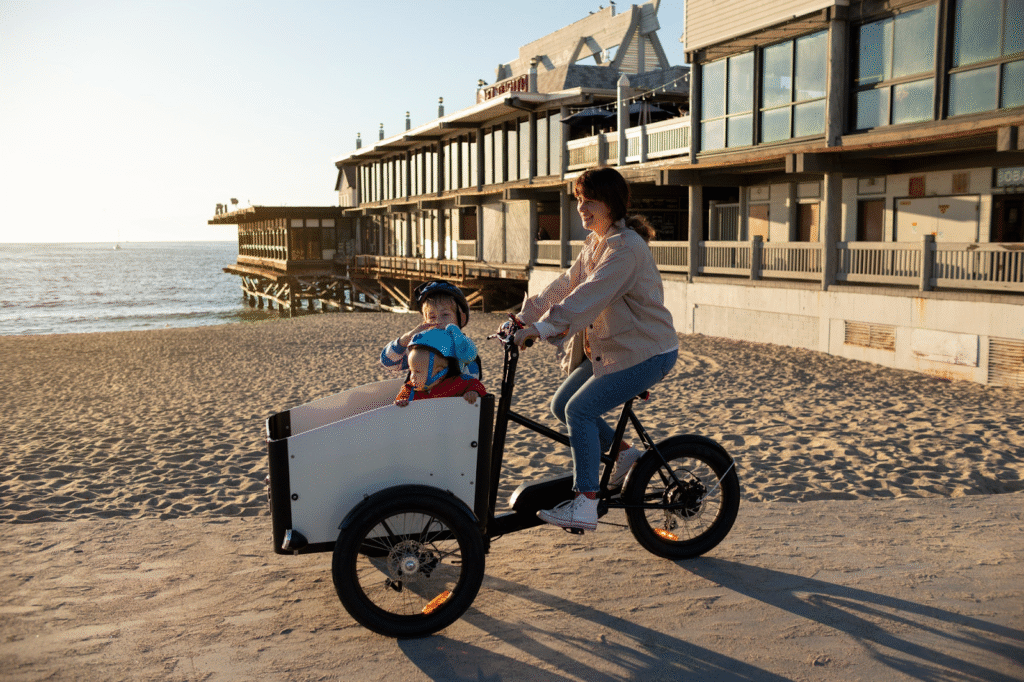
There is a particular kind of morning that many parents and small business owners know well. The one where you are simultaneously trying to get children ready for school, load the car with everything needed for the day, and mentally calculate whether parking at the destination will add another fifteen minutes you do not have. It is not a transport problem in the abstract; it is a daily logistics puzzle that adds friction to life in ways that compound quietly over time. A growing number of people in this exact situation have found an answer that, frankly, sounds improbable until you try it. Today’s generation of electric cargo bikes handles that morning routine differently: no parking problem, no fuel cost, often faster door to door, and most children inexplicably prefer it to being strapped into a car seat.
This is not a guide for committed cyclists trying to squeeze more mileage out of their hobby. It is for families trying to make daily life run more smoothly and for small business owners looking at their operating costs with fresh eyes. Both groups are discovering that a cargo ebike is less of a lifestyle statement and more of a practical tool that happens to be considerably cheaper and more flexible than the vehicle it sometimes replaces.
What Families Are Actually Using These Bikes For
The school run is the anchor use case that most family cargo bike owners start with. It tends to be the one that converts skeptics into advocates fastest, because the improvement in daily experience is immediate and measurable. No searching for a parking spot within walking distance of the school gate. No school-run traffic queue. Children who arrive having been outside and moving rather than staring at a screen from a car seat. Parents who have had fifteen minutes of gentle physical activity rather than fifteen minutes of frustration behind a steering wheel. The switch from car to cargo bike for school runs is one of those changes that people report they wish they had made earlier.
Grocery shopping is the second most common use case and the one where new owners are most frequently surprised. The cargo capacity of a properly set up cargo e-bike is larger than the boot of many small city cars once you account for the physical accessibility of the space. Loading bags into a front box at counter height beats wrestling them into a boat at knee height. The return trip with a full load is where the electric assist earns its price; a motor that flattens hills and makes 30 kilograms of shopping feel manageable transforms what might otherwise be a deterrent into a genuinely easy errand.
Weekend trips and leisure rides with children represent a third category that families often underestimate before they own one. A cargo bike loaded with a picnic, outdoor gear, and two children can cover distances that feel genuinely adventurous compared to a standard family cycling setup. The physical engagement of being outside together, rather than enclosed in a car, changes the character of weekend time in ways that parents consistently describe as positive even after accounting for the additional planning involved.
See also: How Hiring Local Plumbers Transforms Your Home Maintenance
The Small Business Case: Honest Numbers and Honest Trade-Offs
For a small business owner, the question is simpler and harder at the same time: does switching some or all of my delivery or transport operations to a cargo ebike reduce my costs without reducing my service quality? The answer depends heavily on the specific operation, but for businesses covering dense urban areas with loads under 80 kilograms per trip, the numbers tend to support the switch more clearly than most operators expect before they run them.
Consider the daily cost of running a small delivery van in a typical city: fuel at current rates, commercial vehicle insurance, parking costs for each delivery stop, congestion charges where applicable, and routine servicing. Across a working year, that total can easily reach several thousand dollars or pounds. A cargo ebike’s operating cost over the same period is a battery charge per day and occasional brake pad and tire replacements. The capital cost of a quality commercial cargo bike typically pays back against these savings within 12 to 18 months of regular use.
Speed is the less obvious advantage. In dense urban environments during peak hours, a cargo bike traveling in a dedicated bike lane or filtering through traffic consistently completes short delivery routes faster than a van averaging low speeds in congestion and adding parking time at each stop. For local florists, bakeries, pharmacies, caterers, and independent retailers running same-day deliveries within a few kilometers of their base, the cargo bike often outperforms the van on the specific metric that customers care about most: arrival time.

Guide on Selecting the Best Electric Cargo Bike for Multipurpose Use
Families and small businesses share an interesting challenge when choosing a cargo bike: both groups often need the bike to perform well across multiple quite different scenarios. A family bike might need to carry children on Monday, a week of groceries on Wednesday, and camping gear on Saturday. A business bike might carry parcel deliveries in the morning and supplies for restocking in the afternoon. Choosing a model that handles this range well requires a different evaluation approach than buying for a single defined use.
Start with the cargo system rather than the bike itself. Some cargo bikes use proprietary front box systems that are excellent for children but limited for awkwardly shaped commercial loads. Others use open platform or rail-based mounting systems that accommodate a wider variety of aftermarket accessories: pannier systems, lockable cargo boxes, child seats, cargo nets, and custom mounting solutions. For genuinely multipurpose use, the second category offers considerably more flexibility over time.
For business users specifically, the HovCart Cargo e-bike is engineered with commercial utility in mind rather than adapted from a family or leisure design. The frame geometry, cargo capacity, and component specification reflect what a rider needs across a full commercial working day: consistent motor performance under repeated loading, cargo access that makes each stop efficient, and durability built for daily operational demands rather than occasional use. For operators who will depend on the bike commercially, that design intent matters considerably more than spec sheet numbers taken in isolation.
For families wanting multi-purpose capability, the longtail design tends to offer the best balance: it handles similarly to a standard bicycle, accepts a range of cargo accessories, accommodates child seats at the rear while leaving the front handlebar area usable, and fits in more storage spaces than wide front box configurations. It is a sensible default for households whose use case varies week to week.
Durability and Performance: What to Actually Inspect
Durability is one of those qualities that is difficult to evaluate on a test ride and almost impossible to assess from a specification sheet. A bike that feels solid during a twenty-minute demo might develop frame fatigue or component wear issues after six months of daily loaded use that a cheaper build simply was not designed to absorb.
A few indicators that experienced buyers use: look at the welds on the frame, particularly at stress points around the cargo mounting area, the bottom bracket, and the head tube. Clean, consistent welds suggest quality control in manufacturing. Rough or inconsistent welds are a warning sign on a vehicle that will be carrying significant loads regularly. Check the quality of the derailleur and drivetrain components; these take more stress on a cargo bike than on a standard bicycle because of the additional weight through every gear change. Shimano and other established component brands offer meaningful quality tiers that reflect real durability differences, not just price positioning.
Brake quality deserves repetition because it matters so much on a heavy vehicle. Hydraulic disc brakes are the appropriate choice for any cargo bike used regularly with meaningful loads. They provide consistent stopping power across conditions and do not degrade with heat buildup the way mechanical systems can under heavy repeated braking. For a bike carrying children or commercial loads in urban traffic, this is not a specification to compromise on in pursuit of a lower purchase price.
One question worth asking any seller: what is the service interval and parts availability situation for this specific model? A cargo bike from a brand with limited distribution in your market may be difficult and expensive to service when components eventually need replacement. Established brands with local dealer networks and documented parts availability make long-term ownership considerably less stressful.
The Future These Bikes Are Already Building
It would be tempting to frame the growth of cargo ebikes as a trend that might or might not continue. The honest assessment is that the conditions driving adoption are structural rather than cyclical. Urban density is increasing globally, not decreasing. Fuel costs have not shown a credible long-term downward trajectory. City governments are committed to emission reduction targets that require changes to urban transport in ways that consistently favor cargo bikes over vans and cars for short urban journeys.
The infrastructure investment reflects this: dedicated cargo bike lanes, commercial charging infrastructure, business subsidy programs for zero-emission delivery vehicles, and urban logistics partnerships with cargo bike operators are all expanding in cities across Europe, North America, and increasingly in parts of Asia and Latin America. Each piece of infrastructure makes the next rider’s experience better and lowers the threshold for the next business to make the switch.
For families, the long-term picture includes children who grow up experiencing active transport as normal rather than exceptional, who arrive at school having been outside and physically engaged rather than passively transported, and who develop an intuitive sense of their neighborhood geography that is car-based. commuting rarely provides. These are soft benefits that do not show up in cost analyses but that parents who have made the switch tend to mention unprompted as among the things they value most.
For small businesses, the long-term picture is one of operating cost structures that improve relative to competitors who remain dependent on conventional vehicles; as fuel costs, congestion charges, and emission zone restrictions continue to evolve in directions that penalize fossil fuel transport, the cargo e-bike advantage compounds rather than diminishes.
Neither families nor small businesses need to wait for that future to materialize before the economics and the practical case make sense. They make sense right now, on this morning’s school run and this afternoon’s delivery route, for a growing number of people who started out skeptical and find themselves, a few weeks in, wondering why they waited.