

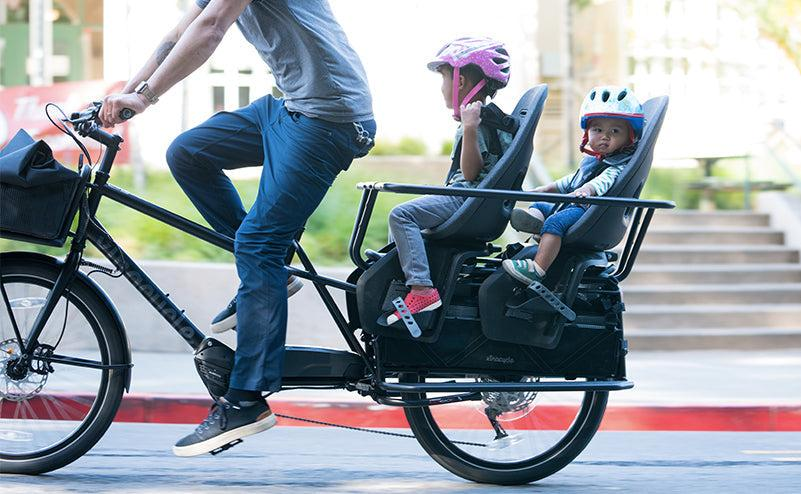
When my second child arrived, the cargo bike setup that had worked perfectly for one suddenly felt like a puzzle I had not finished. The front box had one seat. The baby needed a rear-facing infant position. My older one, then four, still needed a harness rather than just a seat. And I wanted to keep some cargo space for the school bag and whatever else the day demanded.
Nobody had told me that going from one child to two on a cargo bike was not just a matter of adding a seat. It was a reconfiguration exercise that required thinking about weight distribution, age-appropriate restraint, reach to handlebars, and whether the bike could actually handle the combined load without changing how it rode.
Three years and two bikes later, here is what I know about configuring cargo bikes for multiple children that I really wish someone had explained at the start.
Why Modular Seating Matters More Than Seat Count
A lot of buyers look at cargo bikes and count seats. Two seats mean two children; job done. The problem is that seat count tells you almost nothing about whether those seats work well together in practice for children at different ages and sizes simultaneously.
A modular seating system is one where individual components can be reconfigured, added, removed, or repositioned as the children’s ages and needs change. A fixed seating system has a set layout that works or does not work for your specific children, with limited ability to adapt.
The difference matters because family cargo bike use typically spans six to eight years. A child who needs an infant carrier at nine months needs a harnessed toddler seat at two years, a simple bench seat at five, and has probably graduated to their own bike by nine or ten. A modular system grows through those stages. A fixed system solves the problem you have today and may not solve the one you have in two years.
See also: The Future of Technology: 10 Groundbreaking Trends to Watch in 2025
Age Gaps Change Everything About the Configuration
The age gap between your children is the first thing to think through, because it determines how different the seating requirements are at any given moment.
A family with two children under three at the same time needs two fully harnessed positions, ideally with head support for the younger one. The combined weight is relatively low, which suits front-box configurations well. The challenge is fitting two harnessed seats into a box that may have been designed for one.
A family with a four-year-old and a one-year-old needs one fully harnessed infant position and one seat appropriate for an older toddler who has some core stability but still needs proper lateral support. These are meaningfully different requirements, and a box with one-size seating compromises at least one of them.
A family with an eight-year-old and a three-year-old may find that the older child is ready to ride their own bike alongside, which frees the cargo area for the younger child and actual cargo. Planning for that transition when buying the bike changes which configuration makes sense today.
The configuration nobody plans for
Most families underestimate how often they carry one child plus cargo rather than two children. School pickup on a day when one child has a playdate elsewhere. A quick grocery run with just the younger one. Collecting equipment for a weekend activity. A modular seating system that allows easy removal of one seat to create cargo space is worth considerably more in everyday use than a fixed two-seat layout that is difficult to reconfigure.
Front Box Configurations for Multiple Children
Front-load box bikes offer the most flexibility for multiple young children because the box provides a contained space that can be fitted with different seat arrangements.
The standard configuration for two children under five is side-by-side seating with individual harnesses. Both children face forward, are visible to the rider, and have their own restraint system. This works well when the children are close in age and size. When there is a significant size difference, the smaller child may be too loose in a standard harness position designed for an older child beside them.
Some box bikes offer a tandem configuration, with children seated front to back rather than side by side. This narrows the box width requirement, which helps on tight city streets, and allows better size-matching of individual seat positions. The trade-off is that the rear child has a more restricted view and the loading and unloading sequence requires more care.
Infant inserts that fit within the main harness system are essential for children under approximately 18 months. A standard toddler harness is not appropriate for an infant without a proper insert providing head and body support. Check specifically whether the box bike you are considering has a compatible infant insert available, not just an adult-sized harness, before buying if you plan to carry a young baby.
A practical check before reconfiguring seating: load both seats with weights approximating your children and take the bike for a 10-minute ride on your actual route before committing to the configuration permanently. Weight distribution changes significantly between one and two children, and a configuration that feels balanced with one child at 14 kg and one at 22 kg may feel quite different from one 12 kg child centered in the box. Ride before you bolt anything down permanently.
Longtail Configurations for Multiple Children
On longtail bikes, multiple children sit on the extended rear platform. The typical approach is a forward seat for the younger or smaller child, with foot platforms and a handlebar for the older child behind them, or a bench seat setup where both children sit side by side if the platform is wide enough.
Weight distribution on a longtail becomes important with two children. Two children totalling 40 kilograms on the rear platform move the bike’s center of mass significantly rearward, which affects steering responsiveness and makes the front wheel feel lighter. This is manageable with practice but noticeably different from riding with one child. Some longtail riders add a small amount of weight to the front panniers to rebalance the bike when carrying two children on the rear.
Rear platform width is the physical constraint that limits longtail seating for multiple children. A narrow platform suits a single rear seat well but feels cramped with two children side by side. Check the actual platform dimensions against the combined width of two child seats before assuming any longtail can accommodate two children comfortably.
The Weight Limit Question Nobody Asks Loudly Enough
Every cargo bike has a total payload limit. That limit covers everything: the rider, children, cargo, and accessories. With two children, that limit gets reached faster than most buyers expect.
A 75kg rider, two children totalling 35kg, and a basic grocery load of 10kg are already 120kg of payload before the weight of child seats, bags, and the bike itself. On a bike with a 150kg total payload that leaves 30kg of margin. On a bike with a 120 kg payload limit, you are already at or over the limit.
This is not a theoretical concern. Bikes ridden consistently at or above their payload limit wear faster, handle less predictably, and in some cases develop frame fatigue at stress points over time. For a two-child family, the payload specification should be among the first things checked, not the last.
Planning for the Years Ahead, Not Just Today
The most useful framing for modular seating decisions is not what configuration you need this month. It is what configurations you will need across the next five years and whether the bike you are considering can accommodate all of them without major accessory changes.
A bike that handles an infant plus a toddler today, two harnessed toddlers next year, and one older child plus cargo the year after that is a genuinely versatile purchase. A bike that is perfect for today’s configuration but requires a different accessory system for each stage is a more expensive long-term proposition.
The detailed Electric Family Cargo Bike Guide covers modular seating alongside motor power, battery capacity, and the broader technical picture that determines real-world family cargo bike performance. Reading seating configuration in that wider context helps clarify which bike features genuinely support multi-child flexibility and which ones look adaptable in photographs but prove limiting in practice.
For families thinking about how seating configurations fit into the broader evolution of family e-bike design, the overview of the Best Family Ebikes for 2026 shows how manufacturers have responded to real multi-child family feedback in recent generations of cargo bikes, with more genuinely modular systems, higher payload capacities, and seating accessories designed from the outset for the full arc of family use rather than a single configuration snapshot.
What Good Modular Seating Feels Like in Practice
When modular seating is done well, reconfiguring the bike takes about ten minutes with basic tools and produces a setup that feels purpose-built rather than adapted. The harness attachment points are in the right places. The seat height works for the child using it. The weight sits where the bike’s geometry expects it.
When it is done poorly, reconfiguration involves adaptors that do not quite fit, harness straps that reach at awkward angles, and a final setup that technically works but never feels completely right. After a few weeks of daily use the compromises become a background irritation that gradually makes you use the bike less.
The families who get this right tend to be the ones who thought through all the configurations they would need before buying, tested the transition between them at the shop if possible, and bought a bike whose modular system was designed rather than assembled from unrelated components. That planning conversation takes about 20 minutes at purchase. It saves considerably more than 20 minutes of frustration over the following years.



 Smart Card Access Control in Saudi Arabia’s Mixed-Use Developments: Managing Thousands of Credentials Across One System