

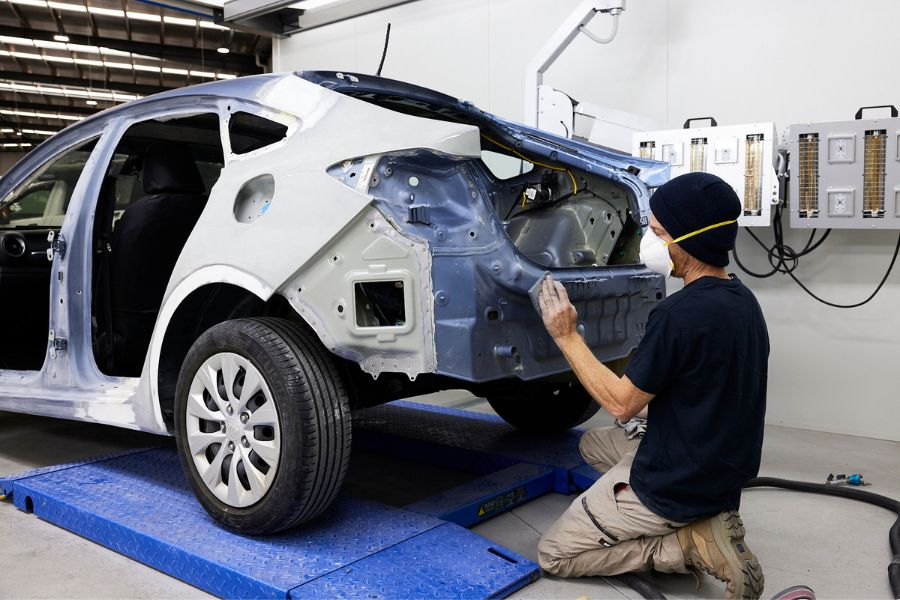
While having an accident is never fun, what you decide to do immediately following the accident can influence how much it costs you in the long run. Drivers often decide to save money rather than repair damage by using the insurance payout or avoid the work on the vehicle altogether, thinking that cosmetic damage is no big deal.
Yet, not doing auto collision repair will affect its resale value dramatically. Relux Collision helps its clients preserve their investment by making sure the vehicles are restored to perfect condition and prevent future problems.
Image Source: Pinterest
Financial Impact of Frame and Structural Damage
Your vehicle’s frame is a key component that holds all other systems and components together, from the safety features to the alignment and drivability. Even a small accident can lead to some slight structural issues. Yet, any hint of misalignment in the frame during a pre-purchase inspection drops the price significantly.
See also: Turbine Blend Polish Peen Services to Improve Turbine Life and Performance
Unibody Distortion Not Obvious
Contemporary cars have unibodies engineered for impact absorption in the case of collision. Distorting or bending of this metal results in loss of structural integrity. Failure to repair such damage means that the car cannot properly distribute the impact energy in any future accidents.
Used car assessors use special measuring devices that help detect the frame shift, and finding out about the damage that is left untreated reduces the trade-in value of the vehicle by up to 50 percent.
Suspension Misalignment and Rapid Wear
Any frame shift inevitably makes the suspension go out of spec. The result of this is extreme misalignment that causes the wheels to be worn unevenly in just a few thousand miles.
Buyers who find the uneven treads on the tires or even feel the pull in the steering wheel during the test drive instantly understand that something is wrong and either offer a low price or make you pay for the suspension rebuild.
Cosmetic Defects Develop into Structural Rust
Paint Layer Disruption
Automotive paint layers include clear coat, base color, and primer layers meant to protect the bare metal underneath. Collision disrupts all protective paint layers and exposes bare metal to air, water, road salt, and humid conditions.
Once moisture enters the metal layer, the process of oxidation starts immediately under the paint layers, causing bubbles and flaking which becomes much more costly to repair compared to the initial scratch.
Deep Corrosion Spread
Rust works just like cancer on automobile sheet metal. From being on the surface, corrosion spreads underneath panels and starts corroding door edges, rocker panels, and wheel well areas.
Buyers inspect used cars very carefully for rust because rusty panels often need total replacement instead of painting. When buyers see rust on a car, it means the car owner did not take care of his/her vehicle, reducing its market value.
Importance of Vehicle History Report in Selling Used Cars
In the modern automotive world, concealing accident history is not possible anymore. Services such as CARFAX and AutoCheck automatically gather information from police, insurance, and body shops reports, requiring full transparency while selling any vehicle.
Accident Indicators and Red Flags
When a prospective buyer reviews a vehicle history report and discovers there is an accident in the vehicle’s history, their attention turns to the quality of the restoration immediately.
Should the report indicate an accident and lack any documentation of repair by a certified auto collision repair facility, buyers raise red flags. The natural assumption will be that the car has some sort of hidden mechanical problem or frame shift that the seller is attempting to hide.
Inherent Diminished Value
Even if a car seems fine aesthetically, an accident indicator will result in inherent diminished value. You can mitigate this issue by offering all necessary documentation that proves the vehicle has been restored using original parts.
The lack of repair documents along with accident records results in buyers reducing their offer significantly to account for the cost of the repairs they may need to do.
Hidden Problems with Electronics, Sensors, and Mechanical Components
ADAS Calibration Failure
Lane departure warnings, automatic emergency braking, and blind-spot monitoring systems are all part of advanced driver assistance systems (ADAS). These systems depend on radar units and cameras installed on the body panel.
Any accident may displace the said equipment or disorient them. In the absence of special auto collision repair services and calibration, the systems will no longer function, displaying warning lights on the dashboard that instantly put buyers off.
Engine and Cooling System Damage
The impact from accidents can often lead to damage of radiators, air conditioning condensers and the cooling fans located in the front fascia. The slightest damage to the radiator tank made out of plastic and bent cooling fin is likely to result in slow coolant leak which causes overheating in the engine.
Buyers that notice warning lights, leakage or excessive heat generation of the engine are going to lower offers dramatically to cover the cost of engine repair.
How Quality Bodywork Ensures Successful Resale?
Reassuring Customers Through Documentation
Showing proof that you have fixed all the damage with professional-grade workmanship is done by producing a well-documented paper trail containing the detailed repair invoices, paint match guarantee and parts invoices.
This gives the prospective buyers the confidence that the vehicle was restored to its original condition by professionals using top-notch materials.
Marketability Through Curb Appeal
The initial look of a car is what determines its price. Any car that has well-aligned panels, perfect factory paint color matching, and immaculate bodywork is bound to fetch premium prices, whether it’s sold through private parties or in a trade-in from dealerships.
Conclusion
Choosing not to have body work done on your car after an accident may appear to be a sensible option for saving money in the short term, but ultimately, it will ruin the resale value of your vehicle. The effects of frame shifts, the spread of rust, faulty sensors, and car history reports all add up to create an expense out of what could have been a manageable problem.


 Thin Crust or Thick Crust: Which Pizza Reigns Supreme?